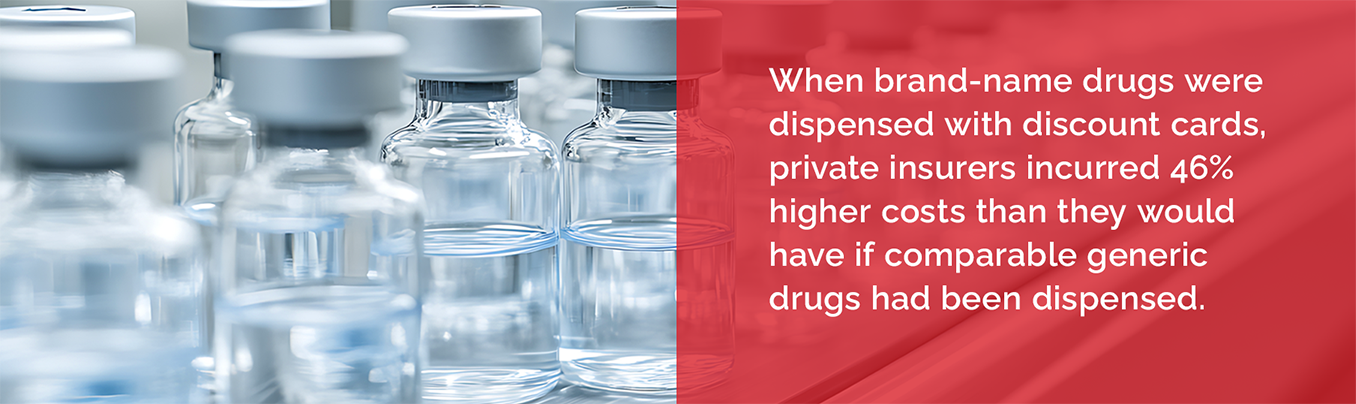
Coupon card campaigns can mislead patients, employers, and policymakers about medication coverage, quality, safety, and the true cost of prescription drugs—while steering prescribing and purchasing decisions away from low-cost alternatives to higher cost brand-name versions.
Canada’s Rx Market Landscape (2025–2030)
According to the IQVIA report, Unlocking Value in Canada’s LOE Wave, 180 specialty brand-name drugs, representing as much as $10 billion in annual spending, will lose patent exclusivity by 2030.² As these patents expire, high-quality, lower-cost High Barrier/Complex Generics will enter the market, creating new opportunities for competition, improved patient access and healthcare savings.
And How Are Brand-Name Manufacturers Responding? More “Loyalty” Coupon Card Campaigns…
In Canada, the prices of generic medicines are regulated, and Complex Generics can deliver savings of up to 75 percent compared with the cost of brand-name drug.
If barriers remain high and adoption of complex generics remains low, manufacturers will have little incentive to bring these products to market, leaving significant savings unrealized for Canadians and our healthcare system. To reduce barriers, a drug plan with a “mandatory substitution clause” is a good start, but to actually fix this problem, drug plans should only reimburse the generic versions of these medicines.
The Timeline to Bring New Generic Prescription Medicines to Canadians
01
Securing Active Pharmaceutical Ingredients (API’s) &Quality Control
•Active Pharmaceutical Ingredients (APIs) are produced internally, or sourced from international suppliers. •API tested for quality and consistency prior to formulation. •Assess quality control and manufacturing practices of supplier
01
Securing Active Pharmaceutical Ingredients (API’s) &Quality Control
•Active Pharmaceutical Ingredients (APIs) are produced internally, or sourced from international suppliers.
•API tested for quality and consistency prior to formulation.
•Assess quality control and manufacturing practices of supplier
Formula Development
•Originator product is reverse engineered for composition of active and non-active ingredients.
• Various formulations of active and non-active ingredients.
•Develop quality control matrix for formulation integrated into manufacturing.
02
Formula Development
•Originator product is reverse engineered for composition of active and non-active ingredients.
• Various formulations of active and non-active ingredients.
•Develop quality control matrix for formulation integrated into manufacturing.
03
Manufacturing and Production Testing
•Analysis of manufacturing complexity and requirements.
•Equipment designed and/or purchased for dedicated production line.
• Quality control matrix developed, tested for full manufacturing.
03
Manufacturing and Production Testing
•Analysis of manufacturing complexity and requirements.
•Equipment designed and/or purchased for dedicated production line.
• Quality control matrix developed, tested for full manufacturing.
Bioequivalence Studies And Clinical Trials
•Bioequivalency studies undertaken to measure the rate and the extent of absorption of generic drug. Results compared to originator drug.
•Comparative study submitted to Health Canada.
04
Bioequivalence Studies And Clinical Trials
•Bioequivalency studies undertaken to measure the rate and the extent of absorption of generic drug. Results compared to originator drug.
•Comparative study submitted to Health Canada.
05
Regulatory and Legal Challenges
•Under Patented Medicines (Notice of Compliance) Regulations a generic manufacturer is required to serve Notice of Allegation on the brand name manufacturer, claiming generic drug will not infringe any relevant patents..
05
Regulatory and Legal Challenges
•Under Patented Medicines (Notice of Compliance) Regulations a generic manufacturer is required to serve Notice of Allegation on the brand name manufacturer, claiming generic drug will not infringe any relevant patents.
•Brand-name manufacturer can apply for an order prohibiting Health Canada from approving generic drug.
Provincial / Territorial Drug Plan Listings
•Once Health Canada has issued a Notice of Compliance (NOC) and approved the drug for sale, it can be sold anywhere in Canada.
•To be reimbursed under provincial drug programs and obtain significant sales volumes, the generic drug must be listed on provincial drug benefit plans and be “interchangeable” with originator.
06
Provincial / Territorial Drug Plan Listings
•Once Health Canada has issued a Notice of Compliance (NOC) and approved the drug for sale, it can be sold anywhere in Canada.
•To be reimbursed under provincial drug programs and obtain significant sales volumes, the generic drug must be listed on provincial drug benefit plans and be “interchangeable” with originator.